FREE SHIPPING ON ORDERS OVER ₹599 · HANDMADE FRESH IN KERALA

What Indians Really Search for About Skin Brightening and Fairness in 2026
The search shift from 'fairness cream' to 'skin brightening' to 'dark spots' — and what it reveals about changing Indian beauty values. Where natural skincare wins this evolving conversation.
7/12/20264 min read
One of the most significant shifts in Indian skincare search behaviour over the past decade is the gradual but consistent decline of 'fairness cream' as a search term and the simultaneous rise of 'skin brightening', 'even skin tone', 'dark spots', and 'tan removal' queries. This is not just a semantic change. It reflects a genuine evolution in how Indian consumers understand and articulate what they want from brightening products.
Understanding this evolution — and the nuanced search intent underneath it — is valuable for any natural skincare brand with brightening-relevant ingredients. Wellniz Coconut Sandalwood, with alpha-santalol's tyrosinase inhibition, sits directly in this conversation.
The Language Shift: What Indian Skin Brightening Searches Reveal
SEARCH QUERY: fairness cream India
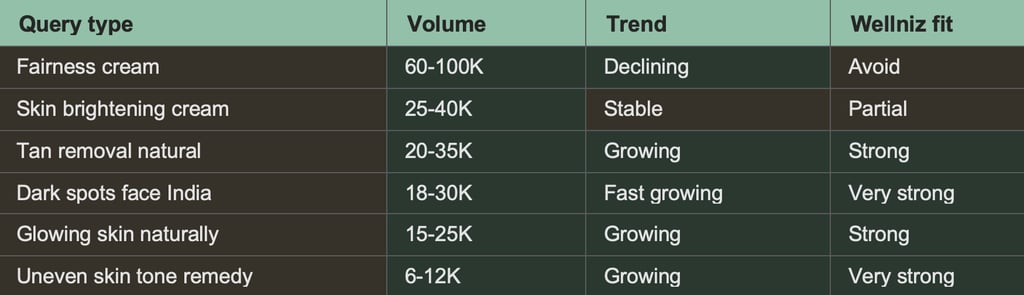
Est. Volume: 60,000-100,000/month declining | Intent: Commercial — but declining YoY
Still by far the highest-volume single brightening query, but consistent year-over-year decline since 2019. Peak was pre-2019 at significantly higher volumes. The term is increasingly associated with problematic bleaching products (mercury, hydroquinone) that consumers are avoiding.
SEARCH QUERY: skin brightening cream India
Est. Volume: 25,000-40,000/month steady | Intent: Commercial — middle ground
'Brightening' replaced 'fairness' in the vocabulary of aspirational consumers. Same intent (more even tone, reduced dark spots) but framed around 'glow' rather than 'lightening'. This is the fastest-growing adjacent term.
SEARCH QUERY: how to remove tan naturally India
Est. Volume: 20,000-35,000/month | Intent: Informational + seasonal
Seasonal spikes after Indian summer (May-September). Entirely different intent from 'fairness' — this is about reversing specific UV-triggered hyperpigmentation, not lightening natural skin tone. Natural tan removal is a legitimate, positive concern.
SEARCH QUERY: dark spots on face India how to remove
Est. Volume: 18,000-30,000/month | Intent: Informational — rising
The fastest-growing cluster in this space. Specifically targeted concern (post-acne marks, sun spots) rather than generalised tone brightening. High intent for products with demonstrated tyrosinase-inhibiting activity.
SEARCH QUERY: how to get glowing skin naturally India
Est. Volume: 15,000-25,000/month | Intent: Informational
'Glow' as the goal rather than 'fairness' is the 2026 framing. This query typically leads to hydration, diet, and circulation improvement content rather than bleaching product recommendations.
SEARCH QUERY: uneven skin tone remedy India
Est. Volume: 6,000-12,000/month | Intent: Informational + commercial
A sophisticated searcher who understands their specific concern — not 'I want to be lighter' but 'I want my skin tone to be consistent.' This is the most aligned with what natural tyrosinase inhibitors actually do.
The Intent Underneath the Queries
A careful reading of these search clusters reveals three distinct underlying concerns that use similar language but require different content responses:
Concern 1: Post-Inflammatory Hyperpigmentation (PIH)
This is the most common and most addressable concern. Acne scars, scratch marks, insect bite marks that leave dark patches. Indian skin's higher melanin content makes PIH more pronounced and more persistent than in lighter skin types. Searches: 'pimple marks removal', 'acne scar dark spots', 'dark spots after pimples'.
Natural response: sandalwood's tyrosinase inhibition + neem's anti-inflammatory action (reduces the trigger for future PIH) + consistent SPF. Wellniz Coconut Sandalwood Moisturiser addresses this directly. The dark spots article is the primary content piece for this cluster.
Concern 2: Sun Tan Reversal
Specifically UV-triggered melanin accumulation in exposed areas — tan lines on wrists, darkening on arms, uneven tone between covered and uncovered skin. Entirely different mechanism from structural skin lightening. Searches: 'tan removal', 'how to remove sun tan', 'skin whitening after sun exposure'.
Natural response: tyrosinase inhibition (sandalwood) to reduce new melanin production + physical exfoliation to remove tan-bearing dead cells (besan 2-3x weekly) + strict SPF to prevent re-tanning. Content and product align strongly here.
Concern 3: The Legacy Fairness Aspiration
Still present but declining. Structurally lighter skin as an aspiration driven by cultural conditioning. This is the segment that bleaching creams (mercury, hydroquinone) historically served. Natural skincare's honest position: we do not bleach or structurally lighten natural skin tone. We address excess melanin from specific triggers (PIH, sun tan). These are different things. The honest framing is a strength, not a limitation.
Wellniz's positioning in this space: explicitly addressing PIH and sun tan as legitimate concerns with evidence-backed natural ingredients (sandalwood, turmeric), while being honest that the goal is even tone, not lighter tone. This is both ethically right and commercially smart — the legacy fairness searcher is declining while the PIH and tan removal searcher is growing.
The Numbers: Where the Volume Lives in 2026
Frequently Asked Questions
Should Wellniz use 'brightening' or 'dark spot' language in its product content?
'Dark spot' is the more specific and more honest framing — it describes a specific concern (PIH, sun tan marks) that Wellniz's Sandalwood product genuinely addresses. 'Brightening' is a broader, higher-volume term that captures attention but requires the content to specify what kind of brightening. Use both: lead with 'dark spots' for specificity and purchase intent, reference 'brightening' for the broader search audience.
Is it appropriate for natural skincare to engage with the 'fairness' search space?
Natural skincare can engage honestly with the underlying skin concerns (PIH, tan, uneven tone) without reinforcing the 'fair is better' value system. The reframing — 'even skin tone' vs 'lighter skin' — is both accurate and ethical. Wellniz should explicitly address this distinction in content to differentiate from legacy fairness brands.
How does sandalwood oil compare to Vitamin C for dark spots?
Both inhibit tyrosinase but through different mechanisms. Vitamin C is a direct tyrosinase inhibitor and also a reducing agent that limits melanin oxidation. Alpha-santalol in sandalwood inhibits tyrosinase through a different pathway and additionally inhibits MMP-1. For daily leave-on use, both are effective; sandalwood's additional anti-ageing benefit makes it more comprehensive for mature or UV-damaged skin.
Get in touch
hello@wellniz.in

Our Promise
No artificial ingredients used in our products
Terms of Service